
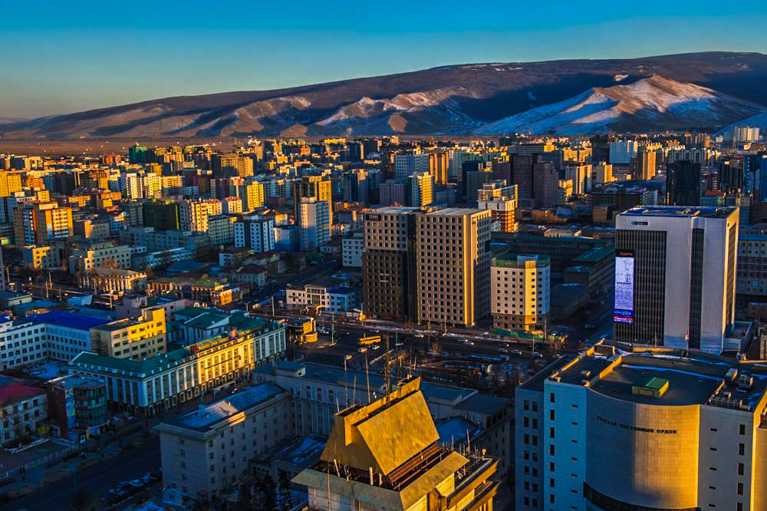
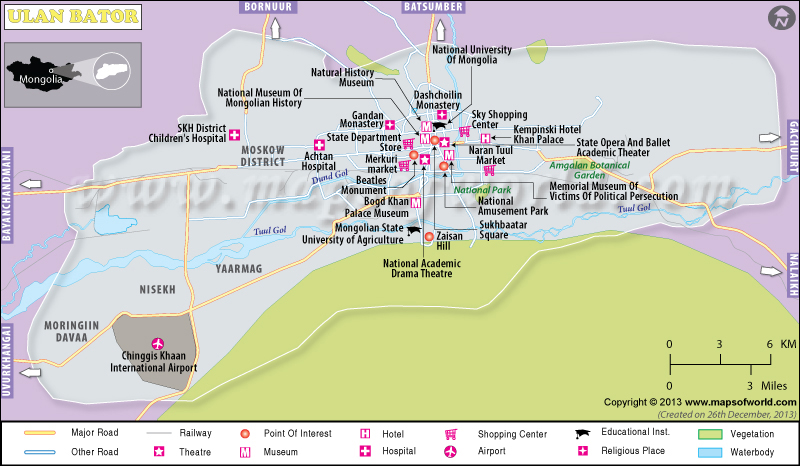
I went out of the city for the weekend and came back in. The contrast between the countryside and the bustling, vibrant, crowded Ulaanbaatar is striking. I have been thinking about how do people who migrate from rural areas to urban areas deal with such a sharp contrast in lifestyle, and what are the strategies that communities experiencing global cultural flows, such as the ones living here in Ulaanbaatar, use in order to avoid the dissolution of their ties to localities, places and ways.
There are plenty of scholars who think about similar questions. So I dug in and visited my good old anthropologist friends to see what they’ve been thinking about. In the following paragraphs, you will find a brief literature review on the question of deterritorialization, globalization and strategies to maintain ties to localities. Mainly, it will be argued that personal and cultural identity is enmeshed with place, informing the localization of global flows.
First, global flows can be absorbed locally by communities and become ‘heterogeneous dialogues’, or ‘indigenized’ (Appadurai, 1996; Sahlins; 1999). This process can be considered a form of resistance, since global ‘scapes’ have to adapt to the new context and negotiate between openness to global flows and the communities’ will to keep cultural identity. Appadurai writes: ‘this is true of music, and housing styles as much as it is true of science and terrorism, spectacles and constitutions.'(ibid., 32). Yet, the relationship between local and global is one of ‘disjuncture’, implying a complicated relation between both : ‘instruments of homogenization that are absorbed into local political and cultural economies, only to be repatriated as heterogeneous dialogues of national sovereignty, free enterprise and fundamentalism´ (ibid., 42). Moreover, global culture is made manifest in national politics, these bodies enacting universalization – but are resisted through riots, refugee flows, and autonomous/independent communities (Scott, 1990). Nevertheless, it is important not to romanticize political resistance, as states have the monopoly on violence and can perpetuate ethnocides or other violent forms of repression (Appadurai, 1996). In the context of deterritorialization, communities may adopt new ‘scapes’, but desire to craft the ‘family-as-microcosm of culture’ may play out against other forms of cultural reproduction (ibid., 45). Thus, cultural identity is negotiated with global flows, both at the political and personal level (Escobar, 2001).
Secondly, production and reproduction of personal and cultural identity is a form of resistance against global flows since it is place bound (Escobar, 2001). Indeed, cultural practices are set in places, and communities attempt to keep their ties to localities through their reproduction. For exemple, local knowledge is a form of place-based consciousness, grants the world with meaning, and identifies individuals with subjectivities (ibid.). Drawing from Harvey (2005), it is possible to show a mutualistic relationship between people and their environment : a ‘place’ is filled with meaning given by individuals/communities, and grounded in social and environmental practices. Nevertheless, mobility, displacement and deterritorialization show that culture is not limited to a given place : rather ‘imagined communities’ are attached to ‘imagined places’ (Akhil and Ferguson, 1997). While mobility destabilizes fixed identities, non-local and local processes continue to produce culture as symbolically anchored to a homeland (ibid.). For example, ‘remembered’ places use memory to continue constructing some boundaries around a homeland (ibid.). More importantly, production of place and culture continues to be local : in the Caribbean, migrants continue to come back to their home island for shared maintenance of family land and visit their house back on the island (Escobar, 2001). These examples show that while migrants embody transnationalism, they use external or global conditions as a way to defend and construct boundaries around the local.
Third, social movements and subaltern strategies of localization are attempts to resist global flows (Scott, 1990). Indeed, people mobilize politically around individual and collective identities, which can result in the opposition of the local against larger political and economic interests (Lovell, 1999, in Escobar, 2001, 149). Similarly, Friedman (1997) claims that social movements destabilize the homogeneous entity of the state or transnational networks, working against ‘culturalism’ i.e., a globalizing strategy aiming at imagining cultural communities. Moreover, integration into a larger networks does not necessarily translate in the strategies of social or cultural survival, as some communities are ‘endosocial’, meaning that they are tied internally, and remain unaffected by the governing state. In Hawaii, the village of Miloli’i is integrated in important ways to the rest of the region and to the United-States, but the social relations of the village are centripetal, organizing internal relations among villagers and rendering them inaccessible to outsiders (Friedman, 1997, 285). Thus, social movements can be complemented by strategies of localization, resulting in the insulation of communities – regardless of their integration in larger networks.
Finally, boundaries construct the cultural proof of localities, authorizing fixity and exclusion. For Douglas (1996), their imagination constructs an ‘idea of “society” ‘ , while maintaining margins and internal structure separated from the external – arguably global flows in our case. These boundaries foster a place-based lifeworld, in which hands-on activities and social life are organized and shared among individuals. According to Yang (1999, 5, in Escobar, 2001), boundaries show that not everything comes from global flows, and often oppose capitalism: they sustain diverse economies, such as subsistence economies, and local initiatives. Boundary-production facilitates the production and reproduction of communities” lifeworlds and worldviews, which are inversely tied to the ‘imagined communities’ and/or ‘imagined places’ .
In brief, strategies of resistance allow for personal and cultural identity to be connected with place, facilitating a ‘localized global’ (Escobar, 2001; Friedman, 1997).
 PASSEGGIO